
Safe lateral distance when overtaking bicycles: rules, practical tips and how a bicycle spacer can help
The most important facts in brief
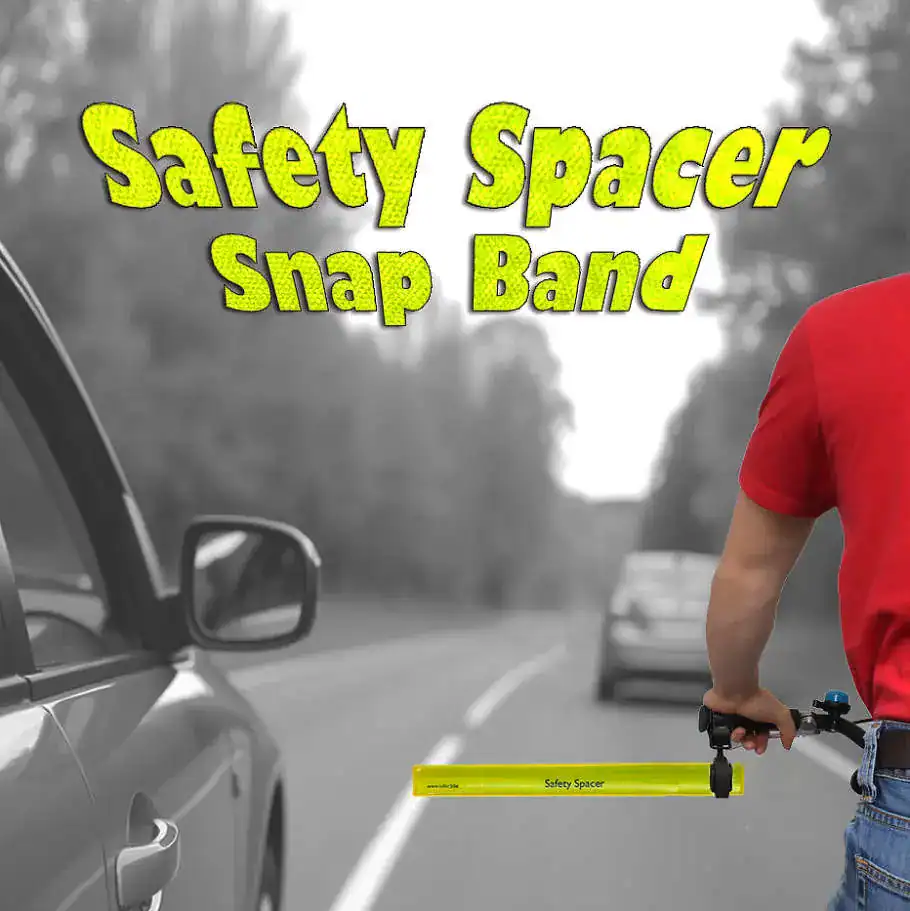
A safe overtaking distance prevents cyclists from falling as a result of dangerous overtaking maneuvers (close pass or near miss). In Germany, cars must maintain a distance of at least 1.5 metres when overtaking cyclists in built-up areas and 2 metres outside built-up areas.Similar rules apply in other countries (please check local regulations). With a bicycle spacer such as the Safety Spacer Snap Band, cyclists can actively contribute to being more visible and thus make overtaking motorists aware of a safe minimum distance.
Key Takeaways – Key Points
What is a safe overtaking distance (lateral safety distance)?
A safe overtaking distance is the lateral distance that an overtaking vehicle maintains from cyclists so that both road users do not come into conflict even with small course corrections, uneven ground or gusts of wind.
The safety distance is not an arbitrary figure, but is based on physical conditions: Cyclists can suddenly change their line due to potholes, crosswinds or evasive maneuvers (e.g., because of broken glass). A sufficient distance gives both sides time to react.
Why is safe distancing so important?
Too little distance when overtaking increases the risk of falling through:
- Contact – handlebars, mirrors, elbows can be grazed or even more than that
- Startle reactions – evasive maneuvers can lead to falls
- Suction/pressure effects – particularly dangerous when buses and trucks overtake
- Unsafe bottlenecks – parked cars (dooring zone) and intersections
💡 Remember: Distance creates reaction time – reaction time prevents accidents.
What overtaking distances apply in Germany – and what applies in other countries?
Germany (brief overview): When overtaking cyclists, a sufficient lateral distance must be maintained. In practice, the clear guideline is: at least 1.5 m in urban areas and at least 2 m outside urban areas.
Important: Rules may vary depending on the country and region. Check the local regulations.
Quick overview: Distances according to situation
| Situation | Good practice (rule of thumb) | Note |
|---|---|---|
| Overtaking in urban areas | ≥ 1,5 m | If not possible: do not overtake, wait |
| Overtaking out of town | ≥ 2,0 m | Higher speeds = more safety reserve |
| Bottlenecks / parked cars | Extra distance | Cyclists should avoid the dooring zone |
| Truck/bus overtakes | Maximum distance | Observe suction/pressure + blind spot |
Practice: How to create more distance (without conflict)
8 specific tips for cyclists
- Make yourself wider: Spacers, panniers, rear-view mirrors and child seats make you wider and you demand more distance when being overtaken.
- Choose your lane carefully: Don’t “stick to the curb”, but ride in such a way that you can avoid potholes and broken glass, for example – and always keep your distance from parked cars (dooring).
- Increase visibility: Reflective spacers, reflective overshoes, good lighting, side reflectors. Light-colored clothing – especially at night, at dusk and in the rain.
- Clear hand signals & eye contact: Show early on what you intend to do.
- Drive with foresight: Observe traffic in the rear-view mirror, recognise bottlenecks and roadworks early.
- Ride defensively instead of fighting: stay calm even when provoked, never provoke yourself.
- Manage risk situations: keep your distance from trucks/buses, pay attention to blind spots.
- Record close pass” and dangerous situations (optional): Depending on the country/region, a dashcam/camera can help to document and report incidents.
7 specific tips for drivers
- If there is not enough space: do not overtake. Waiting a short time is safer than taking a risk.
- Change lanes as you would when overtaking a car: change lanes as completely as possible.
- Adjust speed: The faster, the greater the distance required.
- Do not tailgate or honk: this increases stress and anxiety and leads to incorrect reactions.
- Be particularly careful at junctions: cyclists may have to take evasive action.
- Trucks/transporters: Extra distance, observe blind spots.
- Respect is efficient: safe overtaking maneuvers prevent traffic jams, conflicts and accidents.
Recommended product: Safety Spacer Snap Band (bicycle spacer)
Recommended product
Safety Spacer Snap Band
The flexible Safety Spacer Snap Band is a bicycle spacer that serves as a visual signal to draw the attention of overtaking and oncoming cars to the necessary safety distance. Particularly effective in tight spaces and heavy traffic. Suitable for everyday use because it is handy and easy to fit.
Ideal for:
- Inner-city commuter routes without segregated cycle paths
- Country roads without segregated cycle paths
- Group rides (more visibility)
- Campaigns: #ShareTheRoad / #RespectCyclists
Using the Safety Spacer Snap Band (quick guide)
The set consists of 3 parts:
- Snap Band (slap wrap or snap bracelet), reflective on both sides
- Holder (rotatable and tiltable)
- Elastic silicone band
The holder is attached to the handlebar end with the silicone band. The Snap Band rolled out with two hands is simply pushed into the holder. This can be rotated 360° and tilted 30° in all directions. This means that the rolled-out Snap Band can be mounted at an optimum angle of 90° to the direction of travel for any handlebar shape.
The unrolled Snap Band is given stability by the slightly curved spring steel inside. Pressing lightly on this bulge causes it to retract. It also retracts when it comes into contact with an obstacle.
Comparison of spacers available on the market
1. Safety Spacer Snap Band
Advantages:
- Roll-out and roll-in snap band
- Highly reflective yellow foil with EU approval (EN 17353)
- Reflective on both sides, visible for overtaking and oncoming cars
- Protrudes conspicuously from the handlebar end 30 cm onto the road
- Mounted on the handlebars within the cyclist’s field of vision and reach
- Rolls up when touching an obstacle
- Soft foil leaves no scratches on cars
- Fits every handlebar shape
- Easy to assemble and disassemble
- Fits rolled up in a jacket pocket or handbag
Disadvantages:
- Can be easily stolen if left on the handlebars when parked
2. Safety Wing Fold-Out or Lollipop Reflector
Advantages:
- Firmly bolted to the luggage carrier
- Can be folded in and out
- White reflector at the front, red reflector at the rear
Disadvantages:
- Hard plastic can leave scratches when touching cars
- Orange arm does not reflect
- Small, circular reflectors
- At 30 cm long, barely protrudes beyond the width of the handlebars
- Cannot be combined with panniers
- Mounted on the luggage rack out of sight
3. Pool Noodle
Advantages:
- Indicates approximately the legally prescribed lateral distance
- Soft material leaves no scratches
- Conspicuous and highly visible during the day
Disadvantages:
- Non-reflective at night
- Too bulky when parking
- Too bulky to carry around
- Drivers perceive them as an obstacle and react aggressively
- Not suitable for everyday use, only suitable for bicycle demonstrations
Frequently asked questions (FAQ)
Who or what is Safer.Bike?
Safer.Bike is an international team of cycling designers and technicians who develop, produce and market innovative products to improve the safety of cyclists on the road. The Safety Spacer Snap Band is the first product.
What is special about the Safety Spacer Snap Band?
The yellow snap or clack bands that cyclists and joggers wear on their arms or legs to be more visible have a reflective foil on one side only. A black velour fabric on the inside ensures comfort. However, the Safety Spacer Snap Band only ensures greater visibility when rolled out. The highly reflective foil attached to both sides of the 30 cm long Snap Band makes the handlebar-mounted Snap Band more visible to both overtaking and oncoming drivers.
What are the advantages of the Safety Spacer Snap Band?
It rolls up if you accidentally touch an obstacle with it. You can also roll it in yourself with a click if you want to move past the stopping cars at a red light through the narrow space to the stop line. Even if you forget to roll it up, the soft reflective foil won’t leave any scratches on a car’s paintwork. Mounted on the handlebars, it is always in the cyclist’s field of vision, unlike a fold-out wing or a pool noodle mounted on the luggage rack.
How do drivers react to the Safety Spacer Snap Band?
Studies show that it is large enough to increase conspicuousness and visibility, but not so large that drivers perceive it as an annoying obstacle and become aggressive. It acts as a friendly reminder to keep a safe distance.
Does the Safety Spacer Snap Band on the handlebars interfere steering?
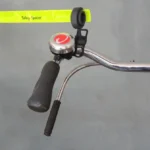
As it can be attached to the handlebars in different places depending on the shape of the handlebars, you can always find a position that doesn’t get in the way. With a weight of just 50 g and a flexible design, it does not affect the steering of the bike.
Is there a risk of injury?
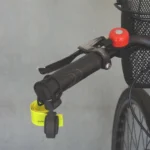
No. The Safety Spacer Snap Band is so flexible that it rolls up or falls off in the event of a collision or fall. And the holder, which is attached with an elastic band, has no sharp edges, so it can’t cause injury either.
How did the idea for the Safety Spacer Snap Band come about?
A problem familiar to all cyclists: hardly any cars keep a safe distance when overtaking. It becomes really dangerous on narrow roads, at night or in heavy traffic. Drivers perceive the danger for cyclists differently or not at all. For them, a cyclist is just a line in the road – at night even just a white or red dot.
That’s why you need to stand out more and become more visible. A highly reflective yellow snap band, which is equally visible from the front and rear and is attached to the handlebars, extends 30 cm onto the road and warns motorists to keep their distance. It can be easily rolled up and stretched out again with a quick press. It is easy to fit, small and light enough to stow in a jacket pocket or handbag.
Sources and legal information
- Overtaking distance measurement on a bicycle: openbikesensor.org/
- Benchmark for cycling close pass detection from video streams: sciencedirect.com
- SNAP – Ultrasound Distance Measurement: exetercyclingcampaign.org.uk
- L’écateur de danger: droitauvelo.org
- Near Miss of the Day: road.cc
- Riding with a Pool Noodle: qz.com
- Germany (StVO, Overtaking): §5 StVO – gesetze-im-internet.de
- ADFC (Allgemeiner Deutscher Fahrrad-Club): adfc.de
⚠️ Note: This article is for general information and does not constitute legal advice. Regional rules may differ – please check the applicable regulations in your country/region.
